
The context
The LATTE workflow involved Kabuverdianu voice recordings produced from written prompts. Linguists recorded the requested sentences; my role began after submission. I reviewed each recording as a Kabuverdianu language specialist and decided whether it met the project's linguistic and audio requirements.
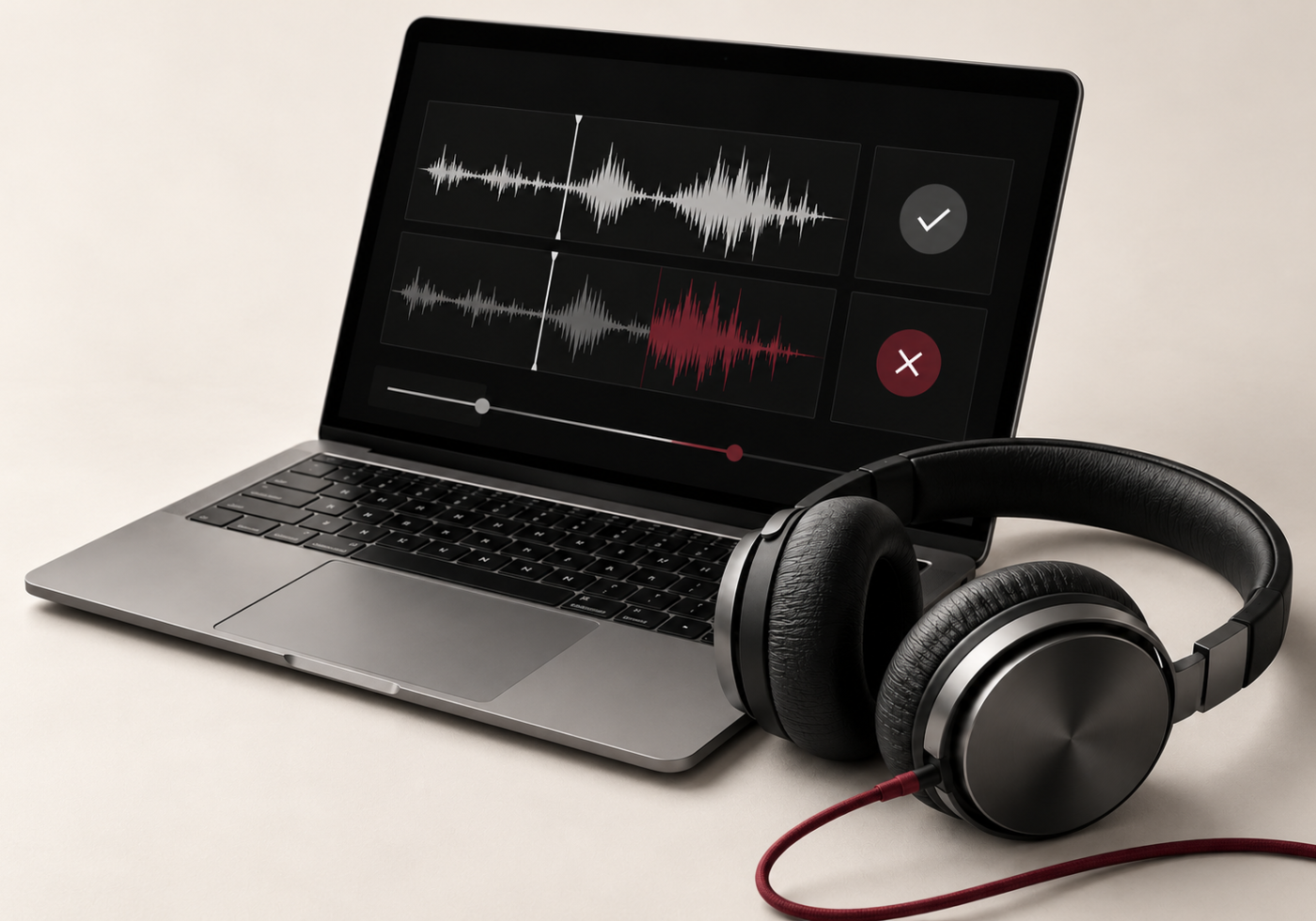
The working interface presented the written prompt and the corresponding audio. That simple arrangement defined the central task: listen closely, compare what was said with what was written, and make a consistent quality decision.
This was not a voice-recording, transcription or translation assignment. It was a human quality-control stage within a larger speech-data workflow.
The challenge
A recording can sound fluent and still contain the wrong word, omit part of the prompt or add material that is not present in the text. It can also reproduce the sentence accurately while failing because pronunciation is unclear, the volume is too low, speech is clipped, or background noise interferes with intelligibility.
The challenge was therefore both linguistic and technical. Every decision had to account for the relationship between the prompt, the spoken Kabuverdianu and the quality of the audio signal. Rejected submissions also needed a specific reason so the recording linguist could understand the problem and submit a corrected version.
At a scale of more than 5,000 recordings, consistency mattered as much as attention to each individual clip.
Scope and responsibility
Working independently through RWS for Meta's LATTE project, I personally reviewed more than 5,000 Kabuverdianu voice recordings. My responsibilities included:
- Comparing the complete spoken submission with the written Kabuverdianu prompt.
- Identifying missing, added, changed or incorrectly ordered content.
- Evaluating pronunciation, clarity and overall intelligibility.
- Checking for background noise, clipping, low volume, interruptions and other recording problems.
- Validating recordings that met the linguistic and audio criteria.
- Rejecting non-compliant recordings and selecting or writing the appropriate reason.
- Providing a clear basis for the linguist to record and submit the sentence again.
- Applying the same decision logic consistently across a high volume of individual tasks.
The quality workflow
- Open the prompt and recording. Review the written Kabuverdianu sentence and load the corresponding audio submission.
- Listen and compare. Check the complete utterance against the displayed text, including word choice, sequence and completeness.
- Assess the language. Evaluate pronunciation, clarity and whether the sentence can be understood as intended.
- Assess the signal. Identify noise, clipping, low level, interruptions or other conditions affecting the usable recording.
- Validate or return. Approve compliant audio. When a recording fails, document the reason so a corrected version can be submitted.
Project scale
The assignment covered more than 5,000 recordings personally reviewed during 2023. Each recording required an individual comparison between written content and spoken audio, followed by a linguistic and technical quality decision.
The number describes recordings reviewed, not hours of audio or unique speakers.
Outcome
The work provided a human linguistic quality gate for the Kabuverdianu recording workflow: compliant recordings were validated, while submissions with content, pronunciation or audio problems were returned with an actionable reason for re-recording.
The outcome claimed here is limited to the completed LQA work. This case study does not claim responsibility for Meta's research methods, dataset design, model development or the subsequent performance of any product or system.
Confidentiality and attribution
The assignment was performed independently through RWS for Meta as the end client. It did not create an employment or representative relationship with Meta.
No voice recording, written prompt, participant identity, project guideline, internal interface or confidential project material is reproduced. The accompanying image is a conceptual editorial photograph and does not show the actual LATTE tool or project data.