
The context
The Future Migration as Present Fact (FUMI) project at PRIO examined how migration imagined as a future possibility can affect people's lives in the present. Its wider research combined ethnographic and survey methods in São Vicente, Serekunda and Tema. My language assignment focused on Kriolu material connected with the São Vicente research and later research documentation; it did not cover fieldwork in all three cities.
Spoken interviews contain details that can disappear when a conversation is reduced to a summary: interruptions, hesitations, informal expressions and references grounded in local experience. The work required Kriolu transcripts that remained close to the recordings and translations that could carry meaning across languages while preserving the structure needed by a research team.
The challenge
The first challenge was to document speech accurately in Kriolu, Barlavento dialect, under a strict-verbatim standard. False starts, interjections, relevant sounds and non-standard expressions had to remain visible. Speaker turns, contextual annotations and regular timestamps made the transcripts navigable against the audio.
The second challenge was translation. Informal words and expressions needed corresponding language in English, with brief contextual explanations where literal translation alone would be misleading. English and Portuguese work followed successive requests whose scope varied by batch; the totals for audio and words describe the collaboration as a whole, not a claim that every recording was translated into both target languages.
A later assignment involved Portuguese translation of research-report material. It required consistent table titles, concise text within table cells, preservation of formatting, and alignment with Kriolu wording in the original survey questions.
Scope and responsibility
PRIO engaged Janilson M. Semedo directly as an independent consultant for language work on FUMI. Responsibilities across the successive assignments included:
- Strict-verbatim transcription of recorded interviews in Kriolu, Barlavento dialect.
- Translation of interview material into English and Portuguese according to the scope of each request.
- Preservation of speaker turns, timestamps, annotations and the agreed document templates.
- Contextual explanation where local language or references could otherwise be misunderstood.
- Translation of related research-report material into Portuguese, including tables and survey references.
- Review for completeness, consistency and formatting before delivery.
- Confidential handling of research recordings and written outputs.
Language and quality process
- Listen and transcribe. Recordings were converted into Kriolu transcripts using consistent spelling within and across files, strict-verbatim conventions and timestamps at regular intervals.
- Translate in context. English and Portuguese material was prepared according to the relevant requests, carrying over the information in the transcripts while accounting for informal speech and locally specific meanings.
- Preserve research structure. Speaker labels, annotations, timestamps, templates and internal references were kept usable for the team's review and navigation.
- Check related documents. In the later report assignment, table titles, wording, layout and references to original Kriolu survey questions were checked for consistency.
Project scale
Across the full series of assignments, the collaboration covered more than 2,300 minutes of interview audio and more than 20,000 words of research-related translation. These are cumulative figures for successive requests, rather than a measure of a single batch or language pair.
Outcome
The assignment provided the FUMI team with Kriolu transcripts and translated research material prepared for use within its research workflow. The contribution described here is linguistic and operational: documenting speech closely, carrying meaning across languages and maintaining the structure needed to work with the material.
This case study does not claim authorship of FUMI's research methods, findings or publications, or any subsequent effect of the research.
Confidentiality and attribution
FUMI was led by PRIO and funded by the European Research Council. Janilson M. Semedo's role was that of an independent language consultant contracted by PRIO, not a member of the research team.
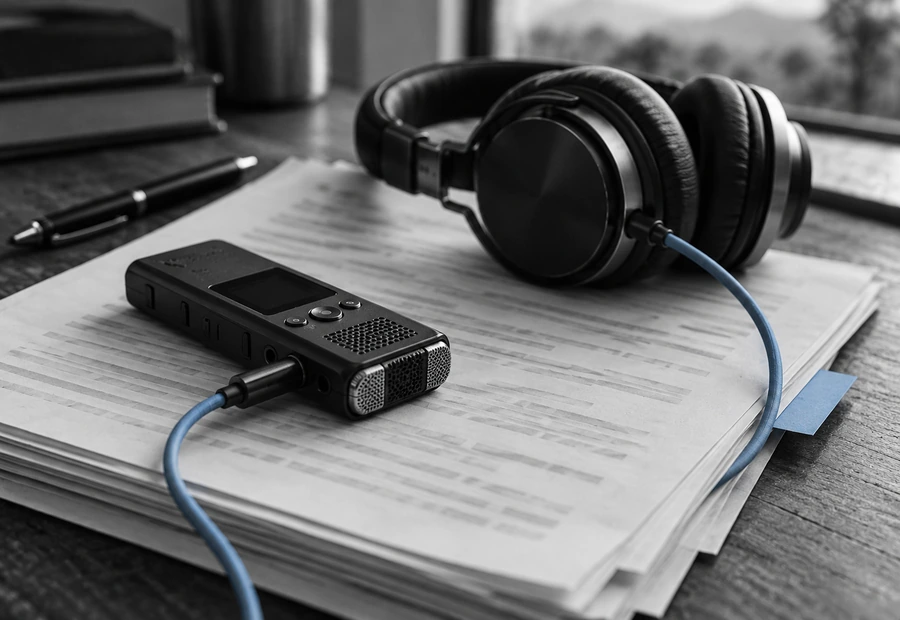
No participant identity, interview excerpt, audio recording, transcript, translation segment, unpublished table or confidential project file is published here. The accompanying editorial image is original conceptual artwork; it does not depict a research participant or use PRIO's logo or illustration.